 Paul Doornbusch
CSIRAC: The First Computer to Play Music
CSIRAC (Council for Scientific and Industrial Research Automatic Computer) was the first computer built in Australia and one of the earliest stored-program computers in the world. It is now recognised as the first computer anywhere to play music.
CSIRAC ran its first program in November 1949. Geoff Hill, Australia’s first software engineer, programmed it to play popular musical melodies through its loudspeaker in 1950 or 1951, the first known instance of a digital computer making music. The music was never recorded at the time, but it has been accurately reconstructed from the original punched-paper program tapes, circuit diagrams, and the recollections of surviving engineers.
The sound-production method was as basic as possible: raw bit-stream pulses from the computer’s data bus were sent directly to an audio amplifier and loudspeaker. Producing a stable, pitched tone from this required considerable programming ingenuity, given CSIRAC’s serial architecture and variable memory-access timing.
In Melbourne from about 1957, mathematics professor Thomas Cherry generalised the music program so that anyone familiar with standard notation could prepare a punched-paper data tape for CSIRAC to perform. This “Music Programme” has meaningful parallels with Max Mathews’s MUSIC I at Bell Labs (also 1957).
It is important to note that the early computer music experiments with CSIRAC and the Ferranti Mark 1 did not use a digital-to-analog converter or pre-calculated synthesis waveforms. The developments initiated by Max Mathews and John Pierce at Bell Labs have the distinction of being the first musical use of a DAC, and the first to investigate the rich musical possibilities of the computer. It is Mathews and Pierce whose work led to the development of computer music as we know it today.
CSIRAC is currently on display at Melbourne Museum. More information can be found at Wikipedia, University of Melbourne, and CSIRO.
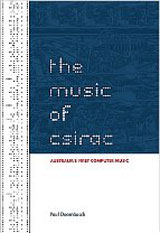
The Music of CSIRAC: Australia’s First Computer Music
Common Ground Publishing, 2005
Available from Amazon and the author via email.
A downloadable PDF of the book is available here.
James Harley, Computer Music Journal 30(3), pp. 83–85. MIT Press, Fall 2006.
“An important, crucial addition to the body of references documenting our field.”
What was the first computer to play music?
CSIRAC, originally known as the CSIR Mk 1, is recognised as the first computer known to play music. Analysis of the machine and its music programme on punched paper tape indicates it was playing music from late 1950. Dick McGee, who joined the CSIR in April 1951, recalls the machine already playing music when he started, a recollection sharpened by the significance of beginning a new job. Music was also clearly remembered by many attendees at the computing conference of August 1951. Both dates predate the independent experiments at Manchester in 1951 and the celebrated work at Bell Labs in the USA in 1957. CSIRAC is widely recognised as the first computer known to have played music.
Why CSIRAC matters
CSIRAC was the first computer in the world to play music, approximately six years before the celebrated work at Bell Telephone Laboratories in the USA. Unlike the Bell Labs experiments that followed, which used a digital-to-analogue converter to synthesise waveforms as an offline process, CSIRAC played music in real time by sending precisely timed pulses to a loudspeaker. Real-time computer music performance with waveform synthesis (with a DAC) was not achieved for approximately another 40 years.
Writing code to produce recognisable musical pitches on a serial computer with variable memory timing was an extraordinary programming challenge. That Geoff Hill and his colleagues solved this problem in 1950–51, before digital audio synthesis, before commercial synthesisers, and before anyone had a conceptual framework for computer music, makes CSIRAC a remarkable milestone in both computing and musical history.
The music played by CSIRAC was never recorded at the time. The reconstruction by Paul Doornbusch and the University of Melbourne team, based on original program tapes, circuit diagrams and the recollections of surviving engineers, is accurate to within fractions of a percent of the original absolute waveform.
Early milestones in computer music
| Computer | Location | Date | Significance |
|---|---|---|---|
| CSIRAC (CSIR Mark 1) | Sydney, Australia | c.1950–51 | First computer known to play music; analysis of the machine and punched paper tape music programme places first music from late 1950, remembered at the August 1951 computing conference |
| Ferranti Mark 1 | Manchester, England | 1951 | Independent early development; earliest surviving recording of computer music, dated 7 September 1951 |
| Pilot ACE (NPL) | Teddington, England | c.1952 | First known instance of a computer generating music autonomously, arising accidentally from diagnostic routines rather than deliberate programming |
| MIRACLE (Ferranti Mark I*) | Amsterdam, Netherlands | 1955 | First known use of a computer to algorithmically generate new musical structures, using a computer implementation of Mozart's dice game; work of David Caplin and Dietrich Prinz at Shell's Koninklijke/Shell-Laboratorium |
| Bell Labs: MUSIC I | New Jersey, USA | 1957 | First use of a digital-to-analogue converter for computer music; foundation of modern computer music synthesis |
Research Papers
Three papers by Paul Doornbusch on the history of CSIRAC’s music and early computer music have been published internationally. All are available for download below and from Academia.edu and ResearchGate.
-
2004
“Computer Sound Synthesis in 1951: The Music of CSIRAC” [PDF]
Computer Music Journal 28(1), pp. 10–25. MIT Press.
The primary research paper documenting the CSIRAC music reconstruction project. Describes the sound-production method, the programming techniques required to generate stable pitches from a serial computer with variable memory-access timing, the reconstruction methodology, and the historical evidence establishing CSIRAC as the world’s first computer to play music. Includes full technical analysis of the original punched-paper program tapes and circuit diagrams.
-
2013
“The Music of CSIRAC, Some Untold Stories” [PDF]
Proceedings of ISEA2013: 19th International Symposium of Electronic Art, Sydney.
Draws on first-hand interviews with original CSIRAC personnel to document stories and background left out of the book, including Geoff Hill’s late-night phone call to his mother to ask if the computer’s scale was in tune, Percy Grainger walking past the Computation Laboratory while CSIRAC was still running, and the internal politics that prevented the music from being broadcast or recorded. Also discusses the research methods used to document and authenticate CSIRAC’s musical activity.
-
2017
“Early Computer Music Experiments in Australia, England and the USA” [PDF]
Proceedings of MuSA 2017, Karlsruhe, Germany.
A comparative critical examination of the earliest computer music activity in Australia (CSIR Mark 1), England (Ferranti Mark 1, Pilot ACE), and the USA (Bell Telephone Laboratories). Analyses why the Australian and English developments, which pre-dated Bell Labs by six or more years and produced real-time computer music) did not lead to further musical investigation, while the USA work under Max Mathews became the foundation of computer music as an international discipline. Includes previously unreported details about the Pilot ACE computer’s capacity to generate its own algorithmic music autonomously from around 1952.
Video: Trevor Pearcey on CSIRAC Music
(If YouTube shows Error 153 above it cannot authenticate some internet traffic. Please click the link inside the error frame to watch the video in a new browser tab.)
The CSIRAC Music Project: Image Gallery
A three-minute video montage of photographs, documents, and images from the CSIRAC music reconstruction project, including the original punched-paper tapes, circuit diagrams, and the engineers who made the music possible. As included on the CD that comes with the book.
(If YouTube shows Error 153 it cannot authenticate some internet traffic. Please click the link inside the error frame to watch the video in a new browser tab.)
© Paul Doornbusch. All images copyright Paul Doornbusch.
The Music: MP3 Recordings
Accurate reconstructions of all music played by CSIRAC, based on the original program tapes and engineering documentation. The reconstruction process is described in full in the Computer Music Journal paper (PDF).
Click a track name to download the file. Use the download link if a track does not play in the browser due to connection speed.
Sydney Programme (CSIR Mk1, early 1950s)
Melbourne Programme (CSIRAC, from c.1957)
This project was generously supported by The Australia Council for the Arts, the University of Melbourne Department of Computer Science and Software Engineering, Museum Victoria, and the Pearcey Foundation.
Related on this site
CSIRAC’s place in the history of electronic and computer music is documented in the Chronology of Electronic and Computer Music, which covers the 1950–1951 period in detail alongside the Ferranti Mark 1 and other early computer music milestones.
Research papers and the 2005 book are listed on the Publications page. Paul Doornbusch’s compositions and other projects are on the Music page.
External links
-
University of Melbourne
The School of Computing and Information Systems documents CSIRAC's design, technical specifications, history and years in operation, including an image gallery and timeline.
-
Pearcey Foundation
The Pearcey Foundation's heritage page on CSIRAC, covering its place in Australian computing history with news, resources and related events.
-
CSIRAC Simulator
A hardware simulator project recreating the CSIRAC operator experience, with technical documentation of the machine's architecture and programming tapes.
-
Wikipedia
The Wikipedia article on CSIRAC covering its history, technical specifications, musical significance and place in Australian computing heritage.